
tactica. doesn’t need investment to survive. That’s precisely why thinking seriously about investors has forced me to ask what capital, and the people behind it, would actually need to add.
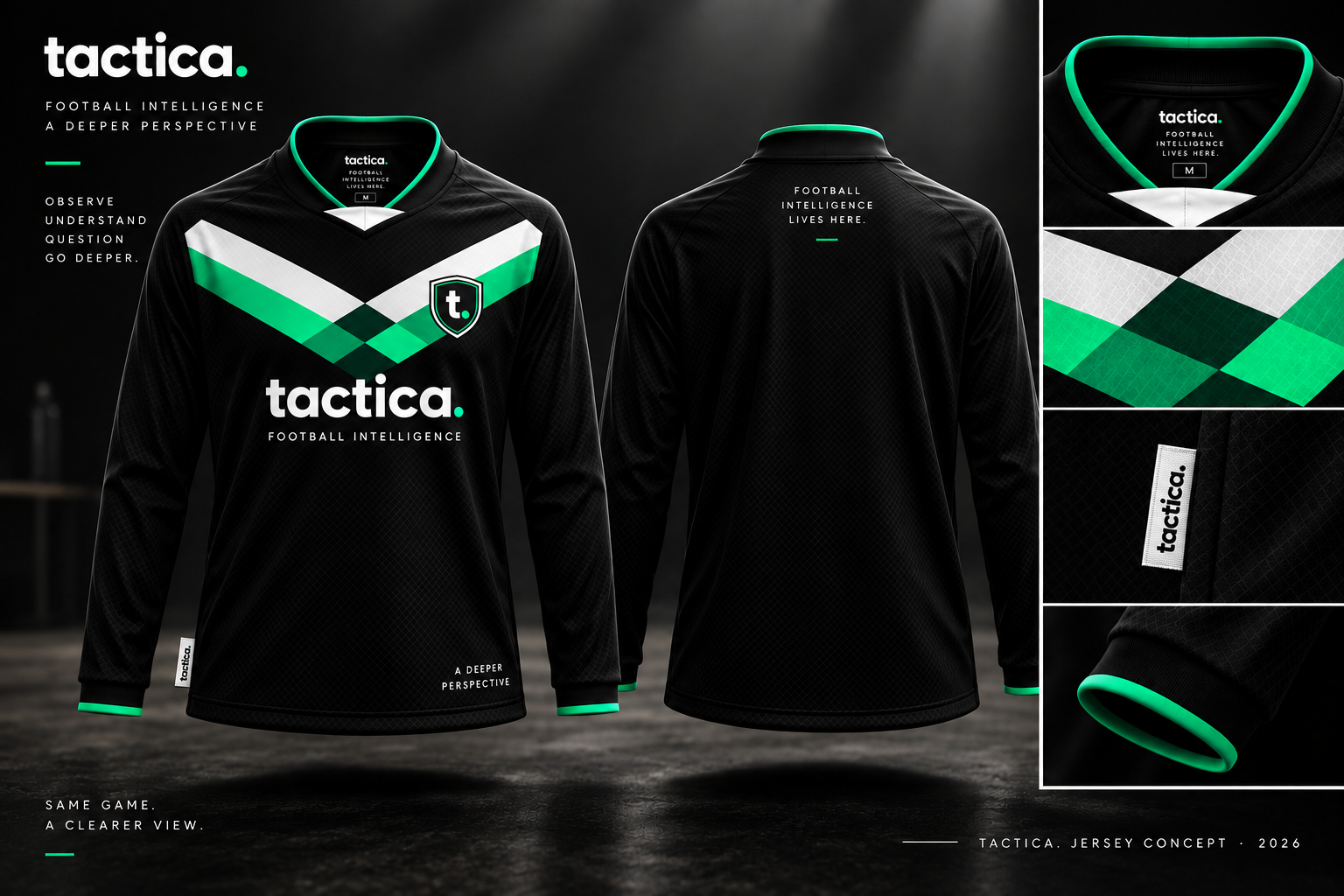
I designed a football shirt recently.
That probably sounds like a strange place to begin an article about tactica.’s future as a company, but the shirt made something feel tangible that until recently had existed mostly as a collection of conversations, financial models and increasingly serious questions.
I don’t think tactica. needs a merchandise range, and I’m not planning to start selling football shirts. What I would genuinely like to do, if tactica. eventually raises investment from the right people, is have a very small number of these shirts properly manufactured and give one to the people who backed the company at the beginning.
Not as corporate merchandise or something handed out after a pitch meeting, but as an object that actually means something. Something that says: you were part of this when the outcome was still uncertain and we were still building it.
The fact that I can now imagine that moment is probably more significant than the shirt itself.
A few months ago, tactica. was something I was building on my laptop around a full-time job. There was no fundraising strategy, no discussion about shareholders and no reason to think particularly hard about company structures. There was football, data, a model and an increasingly long list of things I wanted to understand better.
Since then, the project has had to survive contact with reality.
The project became a product
tactica. developed into a real Closed Beta, which meant people other than me could use it and real football could start testing the assumptions underneath it. Recommendations produced wins and losses, users encountered the product as users rather than builders, and parts of the system that looked perfectly reasonable during development became much harder to defend once there was evidence to examine.
Some of that evidence was encouraging. Across tactica.’s first meaningful observational Performance sample, the model was profitable. Instead of treating that as confirmation that the system was healthy, we audited what sat underneath the result.
That decision ultimately exposed several problems that have fundamentally changed how I think about the product.
We found cases where tactica.‘s explanation of a prediction claimed that a finishing contribution had influenced the calculation when it hadn’t. The prediction itself hadn’t necessarily been calculated incorrectly; the explanation had claimed more causal authority than it had earned. We corrected the explanation and deliberately resisted the tempting alternative of changing the model merely to make the old explanation true.
Another audit exposed a different problem. An 80% probability could appear to represent stronger conviction than a 64% probability even though the percentages described different betting events derived from the same underlying football opinion. That forced us to become much clearer about the distinction between what tactica. thinks will happen in a football match and how that opinion might eventually be expressed as a betting decision.
Elsewhere, missing evidence increasingly forced us to confront what should be a simple principle but is surprisingly difficult to enforce consistently through a real system: if tactica. doesn’t know something, the answer has to be unknown. Missing evidence cannot quietly become certainty simply because certainty is easier for software to work with.
These weren’t isolated engineering fixes. They began to reveal a much larger set of principles around evidence authority, provenance, accountability and what tactica. should be entitled to tell somebody about a football match.
The Closed Beta was doing exactly what I had hoped a beta would do. It was showing me where the original assumptions stopped surviving reality.
That is what led to tactica. 2.0
Eventually there comes a point where repeatedly inserting newly learned principles into an architecture that predates them becomes less attractive than starting again with those principles built into the foundations.
That is what tactica. 2.0 represents.
It is being rebuilt from the ground up using the evidence and lessons from the Closed Beta, but it isn’t entitled to inherit the benefit of the doubt simply because the architecture will be cleaner. Better data authority, stronger evidence contracts, clearer product boundaries and improved performance foundations should create the conditions for better football intelligence, but they don’t prove better outcomes.
Performance Intelligence will have to judge that over time. Users will have to demonstrate through their behaviour whether the product is genuinely better. Retention has to be observed rather than assumed, and commercial value has to be earned.
The rebuild changed another question for me too.
For a long time, I was asking whether I could continue building tactica. The answer is clearly yes. What I’m increasingly asking instead is what tactica. could become if I could give it substantially more time, and whether the right investment could create enough capacity to find out.
That is a very different question.
tactica. doesn’t need investment to survive
This is important because I don’t want to construct a fundraising story around a false sense of urgency.
I can continue bootstrapping tactica. alongside my job. Current infrastructure and development costs remain manageable, and there isn’t an emergency in which the company either raises money or disappears.
The constraints are increasingly time and distribution.
There is only so much company you can build around the edges of full-time employment. There is also only so much that improving the product can achieve if nobody discovers it. A brilliant football-intelligence system that remains largely unknown is still an unknown football-intelligence system.
We’ve started to see small indications that tactica.’s ideas can travel. The Journal is building an owned audience. LinkedIn is helping tactica. establish a professional presence around football, modelling, data and technology. One early Reddit experiment around the Journal generated thousands of views, discussion, organic sharing and readers explicitly telling us they had subscribed.
I find that encouraging, but it would be ridiculous to call it proof of scalable acquisition. We still need to establish whether attention can become product usage, whether those users return, what they repeatedly value and whether enough of them will eventually pay.
Those are much more interesting questions than simply asking how many people saw a post.
Investment could give tactica. more capacity to answer them. It could create enough founder runway to work on the company full-time under the right circumstances, while also providing controlled resources to test distribution properly rather than relying almost entirely on whatever can be achieved around the existing build schedule.
That doesn’t mean more capital is automatically better. We are considering different scenarios, and smaller appropriate investment could still materially accelerate tactica. without requiring the same commitment as a larger full-time-founder raise.
The objective isn’t to raise the largest number possible. It is to understand what additional capital would allow tactica. to prove, and whether exchanging part of the company for that opportunity is actually worthwhile.
Every investor has to compete with bootstrapping
Being able to continue without investment creates what I think is a useful discipline.
If the alternative to a particular investor is the death of the company, it becomes much easier to persuade yourself that almost any capital is good capital. That isn’t the position tactica. is in.
Every investment opportunity therefore has to compete against a credible alternative: I keep my job, continue funding the company myself and build more slowly.
That raises the standard for what an investor should contribute.
Money obviously matters, but I increasingly think the right person should be an asset to tactica. beyond their capital. Relevant experience, distribution, commercial knowledge, network, judgement, useful challenge and familiarity with building early-stage companies could all materially improve the probability that tactica. becomes something sustainable.
Values matter as well.
Trust is becoming deeply embedded in how tactica. is being built. We want to preserve historical recommendations rather than quietly rewriting them. We want Performance Intelligence to show losses as well as wins. We want the model to distinguish what it knows from what it doesn’t, and we want recommendations to remain downstream of the football intelligence rather than allowing commercial incentives to manufacture them.
It would be strange to build the product around those principles and then become indiscriminate about who owns part of the company behind it.
If somebody eventually becomes a tactica. shareholder, I want their involvement to make the company stronger. Otherwise, continuing to bootstrap remains a perfectly reasonable answer.
Preparing isn’t the same as raising
The investment work has become considerably more serious over the last few weeks, but there is an important distinction between preparing to raise capital and actually raising it.
There is no open tactica. investment round being announced here. Nothing has been raised, there are no agreed investment terms and no investor agreement exists.
What has started is the work required to decide whether fundraising makes sense and what a sensible version of it might look like.
We are researching investors across SportsTech, wagering, consumer growth, distribution and early-stage company building. We’re modelling different capital scenarios and thinking much more carefully about what any funded period would actually need to prove.
We’ve also established the content authority for a future investor pitch deck. Interestingly, we’ve deliberately stopped before designing the deck itself.
That is intentional.
I don’t want to spend time creating a beautiful presentation selling a version of tactica. that the product hasn’t earned yet. The investment proposition can be researched, challenged and assembled while tactica. 2.0 is being built, but the polished deck can wait until the product is sufficiently mature to support the story we’re asking somebody to believe.
There is already enough startup theatre in the world. tactica. doesn’t need to contribute more of it.
The harder question is whether we can make tactica. known
Investment discussions have also forced me to think differently about marketing.
I’ve always found the product itself easier to obsess over because the work is tangible. You can improve an API, fix a model problem, rebuild a page or audit a dataset and point to what changed.
Distribution is less comfortable because it forces the company into contact with people who have no reason to care.
That is precisely why it matters.
There is already an enormous audience around football, betting, statistics and analysis. The existence of that audience doesn’t mean tactica. automatically deserves any of it. We still have to find the people for whom the product solves something meaningful, explain tactica. clearly enough for them to understand it and then give them enough value to come back.
If that starts working, we need to understand why. If it doesn’t, more advertising isn’t going to rescue a proposition people don’t value.
This is where I think investment could be genuinely useful. Not as permission to spend recklessly on acquisition, but as capacity to run controlled experiments and determine whether tactica. can turn attention into retained product behaviour and eventually sustainable commercial value.
That evidence would tell us far more about the company than a polished investor deck ever could.
The shirt made all of this feel strangely real
Which brings me back to the jersey.
The concept is unmistakably tactica.: black, white and green, with Football Intelligence across the front and a small tactica. label stitched into the side. On the back is a simple line:
FOOTBALL INTELLIGENCE LIVES HERE.
I would genuinely love to have it manufactured properly one day.
Not hundreds of them, and not because tactica. suddenly needs a merchandise business. I like the idea of producing a small number for the people who genuinely became part of the company’s beginning.
A few months ago, imagining that would have felt absurdly premature. tactica. was something I opened on my laptop after work. Now I’m having serious conversations about company structures, capital, ownership, distribution, shareholders and what kind of people I would actually trust to own part of something I’ve spent so much time building.
There is excitement in that, but there is responsibility too. Taking somebody else’s capital would create an obligation to use it intelligently. Giving somebody ownership would create a relationship that could last far longer than any individual product decision. Moving from employment to tactica. full-time would change the personal stakes considerably as well.
None of those things should happen simply because the possibility is exciting.
They should happen only if they make sense.
Perhaps one day I’ll hand somebody one of these shirts and be able to tell them that they backed tactica. while we were still building it. I like that thought, partly because a physical object has a way of making an otherwise abstract future feel real.
But we’re not there yet.
There is still a product to build, an audience to earn, a business model to prove and a great deal of evidence we don’t yet have.
And somewhere inside all of that, there may be a company worth building properly.