
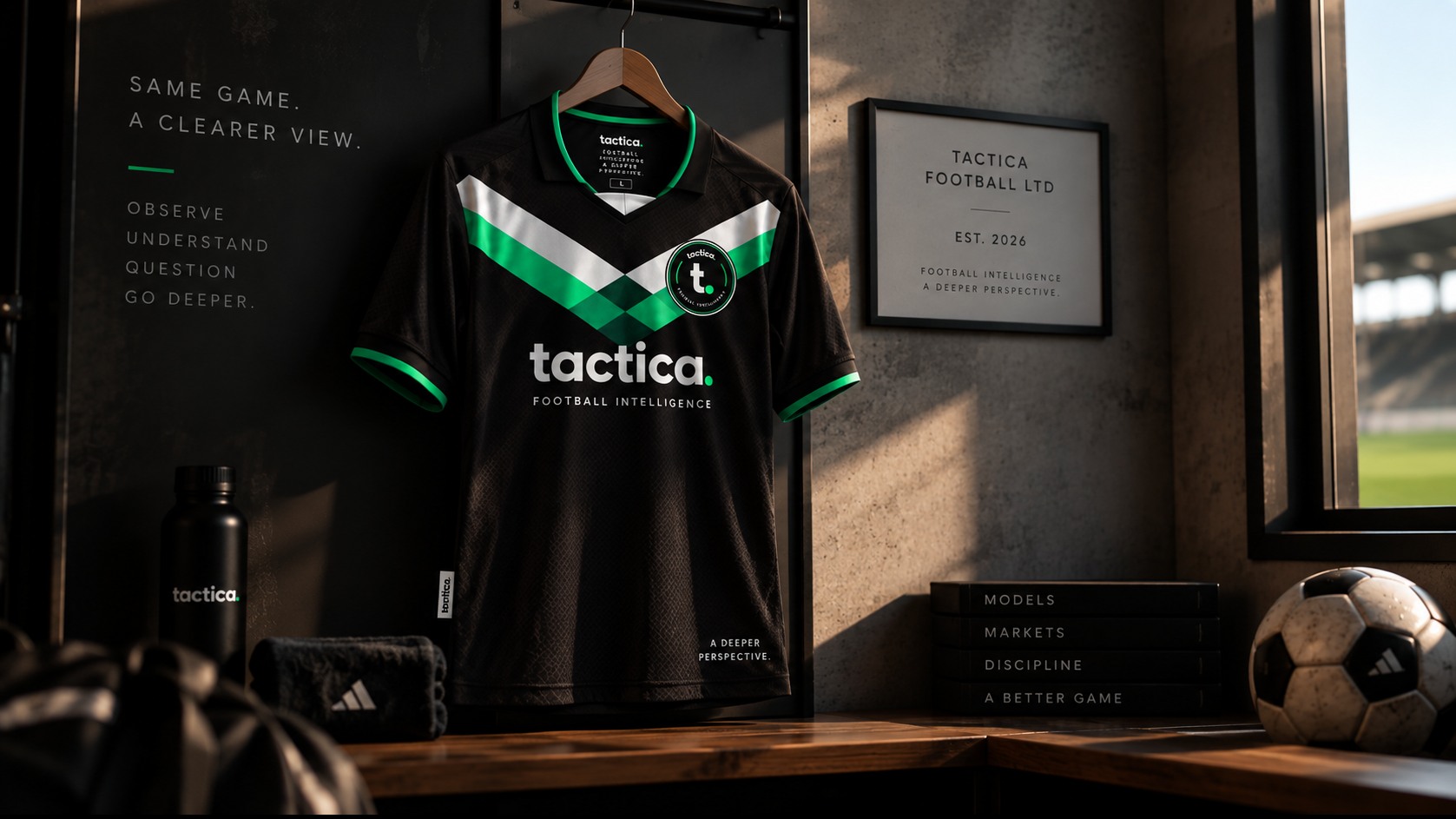
When I started building tactica. in June, I wasn't trying to start a company. I was trying to build a football model.
There wasn't much reason to think beyond that. I was building something on my laptop around a full-time job, paying the relatively small costs myself and trying to work out whether the idea was any good.
Today, TACTICA FOOTBALL LTD exists.
The distance between those two sentences feels much greater than the four months separating them, but the decision to incorporate didn't arrive as some grand change of ambition. It came from a series of increasingly practical questions that became harder to answer while tactica. remained an informal project.
Who owns the software? If tactica. starts receiving subscription revenue, where should that money go? Who signs a commercial agreement? If somebody eventually invests, what are they actually buying shares in? If tactica. one day employs somebody, who employs them?
None of those questions mattered very much when I was experimenting with a model on my laptop. They matter now.
I think the order matters
It's remarkably easy to create the appearance of a company.
You can register one, buy a domain, set up an email address, open a business bank account and give yourself a title. None of that tells you whether you've built anything useful.
That's one reason I'm glad I didn't start there.
tactica. had to become something first.
The original model developed into a product, and that product went into Closed Beta. Other people started using it. Real matches gave us evidence to examine. Some assumptions survived and others didn't.
The Closed Beta ultimately did what I wanted it to do. It exposed enough about the original product, model and underlying systems to change how I thought tactica. should be built. Those lessons are now feeding directly into tactica. 2.0, which is being rebuilt from the ground up rather than treating the beta as something that simply needs polishing for a larger audience.
While that was happening, tactica. also started accumulating things that needed an owner.
There is software and intellectual property. There are operating costs and supplier relationships. There is a brand. Commercial conversations have started. Subscription revenue is part of the future business model. Investment is being explored seriously enough that ownership and company structure can no longer remain abstract questions.
Keeping all of that attached indefinitely to me personally stopped making much sense.
The company is a consequence of that, rather than an attempt to manufacture it.
Somewhere along the way, ownership became real
This is probably the part of incorporation I've found most interesting.
Until now, tactica. could still be described quite literally as something I owned personally. I paid for it. I built it. The software and other assets being created around it ultimately sat with me.
That arrangement is perfectly reasonable for an early side project. It becomes less satisfactory as the project starts behaving like a business.
If tactica. earns money, I want that money to belong to tactica.'s company rather than disappear into the blurred boundary between me and the product. Genuine company costs should increasingly be paid by the company. Commercial agreements should be entered into by the business they relate to. Intellectual property needs clear ownership.
Investment makes the distinction even sharper.
There is no tactica. investment round being announced here and nothing has been raised. I'm still researching what appropriate funding might look like and whether bringing outside capital into the company would create a better outcome than continuing to bootstrap it.
If that does eventually happen, though, an investor needs something clearly defined to invest in. They aren't buying a percentage of an idea on my laptop. They would own shares in a company that owns and operates the relevant business.
Creating that structure before it is urgently needed feels considerably more sensible than trying to untangle everything when somebody is already waiting to sign an agreement.
From today, tactica. starts paying for tactica.
This is the practical change I suspect I'll notice most.
Until now, tactica. has largely been funded by me personally. That was the simplest arrangement while it was an early project, but it shouldn't remain the default now that a company exists.
The principle we've established is simple:
From today, tactica. starts paying for tactica.
That doesn't mean moving every historical transaction around or casually reimbursing myself for anything that looks vaguely related to the project. Existing costs need to be classified properly, particularly where something predates incorporation, and there will inevitably be areas where accounting or tax treatment needs proper advice.
It means establishing the boundary correctly from this point forward.
The company now has its own business bank account. Company income belongs there. Genuine company expenditure should increasingly be paid from there. Records and receipts need to be maintained properly, and personal expenditure shouldn't casually pass through the business.
None of this is particularly glamorous, but I find the principle quite satisfying. tactica. is beginning to carry its own financial footprint rather than existing permanently as a collection of charges on my personal accounts.
Incorporation doesn't prove anything
I want to be careful not to attach significance to this that it hasn't earned.
Registering TACTICA FOOTBALL LTD doesn't make tactica. a successful business.
It doesn't improve the model. It doesn't bring in users. It doesn't prove people will pay for the product, or that those who try tactica. 2.0 will find enough value to keep coming back.
Those remain much harder questions.
There is a lot of company-building activity that can feel like progress without actually improving the underlying business. Registering entities, opening accounts, preparing investor materials, discussing future partnerships and setting up administrative systems can consume enormous amounts of time while the product itself goes nowhere.
I don't want tactica. to fall into that trap.
The company exists to support what we're building. It doesn't get to replace the work of building it.
That means tactica. 2.0 remains the priority. Incorporation hasn't changed the product roadmap, and I'm not suddenly diverting time into creating the appearance of a larger organisation than the one that actually exists.
Right now, the company is small because the business is small. That's fine.
So when does a side project need a company?
I don't think there is a universal answer, and I certainly wouldn't suggest that everybody with a side project should rush to incorporate one.
There would have been little benefit in creating TACTICA FOOTBALL LTD when I started building tactica. in June. At that stage I didn't know what the product would become, and I hadn't accumulated enough evidence to know whether it was worth pursuing seriously.
What changed wasn't a sudden decision to become a founder. It was the amount of real activity accumulating around the product.
The software became more substantial. People started using it. The Closed Beta exposed weaknesses and forced better decisions. A complete rebuild began. Commercial relationships started becoming real rather than hypothetical. Investment became something worth investigating properly. The prospect of future revenue became concrete enough that I needed to think about who would actually receive it.
Eventually, the informal structure started creating more awkwardness than the formal one.
That's the point tactica. has reached.
The company is catching up with the product
There is now another layer of work that didn't exist when I began in June. Company records need maintaining. Costs need classifying. Intellectual property and business assets need clear ownership. Contracts need the right legal counterparty. Tax and accounting obligations need to be understood rather than guessed at.
I don't expect much of that work to make interesting Journal material, and that's probably how it should be. Most of running a company isn't an announcement.
What matters is that the structure now exists to support what tactica. might become.
When I started building the product, I didn't create a company and then look for something for it to do. I built something first and kept following the requirements that came with making it real.
Eventually, one of those requirements was a company.
Today, TACTICA FOOTBALL LTD exists.